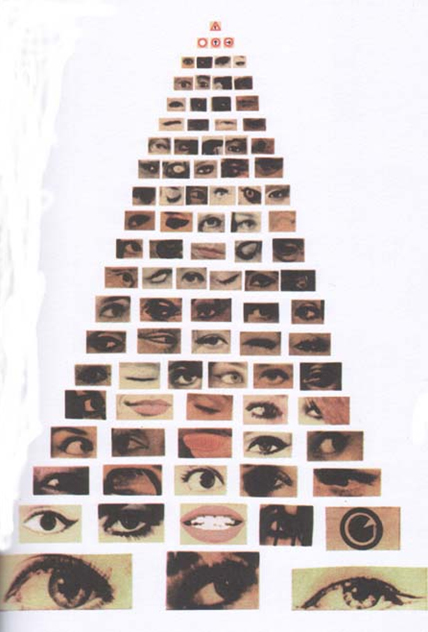
Before beginning to examine concrete poetry and its relation to digital poetry, I must get something out of the way. In the "Pilot Plan for Concrete Poetry" by Augusto de Campos, Decio Pignatari, and Haroldo de Campos, they make several erroneous references to the Chinese language. I have already blogged about the concept of ideogram elsewhere. My beef is with the way they describe Chinese as an isolating language (as does Wikipedia) in that it offers a "pure relational syntax, based exclusively on word order."
This comes from an erroneous understanding of Chinese grammar, which, while it is far less inflected than English (and miles away from something like Russian), nonetheless relies on other grammatical markers to create syntax. Let's take classical Chinese because that's shown to be more isolating than modern Chinese. One of the first things a student of classical Chinese learns is the A B 也 [yě] pattern, which equates A with B. Definitions are written with this pattern, such as "孔人名也" [kóng rén míng yě], which translates as "Kong is the name of a person." The particle 也 is essential to the meaning of the sentence, not the word order. It's kind of surprising that they'd get this so wrong because Pignatari does make a correct reference to the Chinese character for sun, 日 [rì], in one of his concrete poems on the word LIFE.
With that monkey slain, I move on to the elephant in the room: concrete poetry. Let me begin by some remarks by Mary Ellen Solt from her introduction to Concrete Poetry: A World View. After admitting the difficulty of finding a unifying principle for concrete poets, she gives a few: "concentration upon the physical material from which the text is made," a focus on "reduced language," "making an object to be perceived rather than read," and a view that "the old grammatical-syntactical structures are no longer adequate to advanced processes of thought and communication in our time." Basically, concrete poetry marks a shift away from emotive and representational language, which it seems we've outgrown in this advanced day & age.
Let's look at two images of concrete poems to see how/if this plays out. The first is a page from Steve McCaffery's "Carnival." Here the emphasis is on overall visual design, produced by a typewriter. Letters appear in strings, clusters of various density, semicircles, etc. The emphasis appears to be away from representation, toward the raw materiality of the typewritten page (although we are viewing it on a computer screen). The design is quite beautiful, in fact: somewhere between a photograph of distant stars and the better kind of abstract painting.
However, then I notice that the big, falling letters on the right-hand side spell "PLUUUUUGE," with the last two U's turned upside-down to look like N's, thus reading "plunge." Now we have the word "plunge" representing its meaning (in a very emotive way, I might add). Also, I find on the right-hand side the "penetration to the white experience between the words." Ignoring the racial undertones, this is a very literal representation of what's going on in McCaffery's work.
The next image is from a work (or several works?) by Kitasono Katsue (北園 克衛). Here, again, the emphasis is placed more heavily on the design aspect, with still a little bit of representation involved (such as with the "Siamese Twins" in the bottom right-hand corner or the "Egyptian Cross" in the bottom left-hand corner). Actually, these may be book covers he's designed (I just did a Google image search), but no matter: one thing we've established in class is that if you critique it as poetry, it is poetry.
What I've been wondering with regard to concrete poetry is what separates it from comics. Clearly, concrete poetry allows "non-linguistic material" in such works as "the 'Popcreto' of Augusto de Campos" and "the plastic poems of Kitasono Katsue" (to quote from Solt). It also allows some element of representation, as I've just demonstrated.
Case in point, a "Quimby the Mouse" comic by Chris Ware. (Parenthetical remark: Ware does all his artwork by hand, none by computer, although he obviously has to scan his work to reproduce it as a comic.) Here we have a slightly more representational use of both language and art. The sentence is coherent (if somewhat colloquial throughout and mirrored at one point) and the drawings clearly depict a mouse, a landscape, a cat head, etc. There's also an implied narrative on both the visual and verbal levels, which we have not found in any of the concrete poems viewed thus far.
However, much like concrete poetry, the emphasis is on design and on stretching the capabilities of word & image. The words are as visually significant as the images, and the images invite a "reading," as if they were words. Meaning emerges from the play between the two levels of artistry. To me, this sounds a lot like concrete poetry.
There's more to say on that, but I'd like to turn my attention to "Jabber," the Jabberwocky Engine created by Neil Hennessy. First of all, it eschews images to focus purely on the verbal level. Also, it seeks to be nonsensical, with meaning instead created from the concept.
And yet I find it full of representation still: the words move like "molecules," as his artist statement says, and combine to create "portmanteau words [sic]" in a way that sub-atomic particles combined to create new elements in the first stages of the universe.
Also, after letting the engine run for about 20 seconds, I exported the word list, which read:
This comes from an erroneous understanding of Chinese grammar, which, while it is far less inflected than English (and miles away from something like Russian), nonetheless relies on other grammatical markers to create syntax. Let's take classical Chinese because that's shown to be more isolating than modern Chinese. One of the first things a student of classical Chinese learns is the A B 也 [yě] pattern, which equates A with B. Definitions are written with this pattern, such as "孔人名也" [kóng rén míng yě], which translates as "Kong is the name of a person." The particle 也 is essential to the meaning of the sentence, not the word order. It's kind of surprising that they'd get this so wrong because Pignatari does make a correct reference to the Chinese character for sun, 日 [rì], in one of his concrete poems on the word LIFE.
With that monkey slain, I move on to the elephant in the room: concrete poetry. Let me begin by some remarks by Mary Ellen Solt from her introduction to Concrete Poetry: A World View. After admitting the difficulty of finding a unifying principle for concrete poets, she gives a few: "concentration upon the physical material from which the text is made," a focus on "reduced language," "making an object to be perceived rather than read," and a view that "the old grammatical-syntactical structures are no longer adequate to advanced processes of thought and communication in our time." Basically, concrete poetry marks a shift away from emotive and representational language, which it seems we've outgrown in this advanced day & age.
Let's look at two images of concrete poems to see how/if this plays out. The first is a page from Steve McCaffery's "Carnival." Here the emphasis is on overall visual design, produced by a typewriter. Letters appear in strings, clusters of various density, semicircles, etc. The emphasis appears to be away from representation, toward the raw materiality of the typewritten page (although we are viewing it on a computer screen). The design is quite beautiful, in fact: somewhere between a photograph of distant stars and the better kind of abstract painting.
However, then I notice that the big, falling letters on the right-hand side spell "PLUUUUUGE," with the last two U's turned upside-down to look like N's, thus reading "plunge." Now we have the word "plunge" representing its meaning (in a very emotive way, I might add). Also, I find on the right-hand side the "penetration to the white experience between the words." Ignoring the racial undertones, this is a very literal representation of what's going on in McCaffery's work.
The next image is from a work (or several works?) by Kitasono Katsue (北園 克衛). Here, again, the emphasis is placed more heavily on the design aspect, with still a little bit of representation involved (such as with the "Siamese Twins" in the bottom right-hand corner or the "Egyptian Cross" in the bottom left-hand corner). Actually, these may be book covers he's designed (I just did a Google image search), but no matter: one thing we've established in class is that if you critique it as poetry, it is poetry.
What I've been wondering with regard to concrete poetry is what separates it from comics. Clearly, concrete poetry allows "non-linguistic material" in such works as "the 'Popcreto' of Augusto de Campos" and "the plastic poems of Kitasono Katsue" (to quote from Solt). It also allows some element of representation, as I've just demonstrated.
Case in point, a "Quimby the Mouse" comic by Chris Ware. (Parenthetical remark: Ware does all his artwork by hand, none by computer, although he obviously has to scan his work to reproduce it as a comic.) Here we have a slightly more representational use of both language and art. The sentence is coherent (if somewhat colloquial throughout and mirrored at one point) and the drawings clearly depict a mouse, a landscape, a cat head, etc. There's also an implied narrative on both the visual and verbal levels, which we have not found in any of the concrete poems viewed thus far.
However, much like concrete poetry, the emphasis is on design and on stretching the capabilities of word & image. The words are as visually significant as the images, and the images invite a "reading," as if they were words. Meaning emerges from the play between the two levels of artistry. To me, this sounds a lot like concrete poetry.
There's more to say on that, but I'd like to turn my attention to "Jabber," the Jabberwocky Engine created by Neil Hennessy. First of all, it eschews images to focus purely on the verbal level. Also, it seeks to be nonsensical, with meaning instead created from the concept.
And yet I find it full of representation still: the words move like "molecules," as his artist statement says, and combine to create "portmanteau words [sic]" in a way that sub-atomic particles combined to create new elements in the first stages of the universe.
Also, after letting the engine run for about 20 seconds, I exported the word list, which read:
horaderl
humaryin
ancaluai
arne
depeacor
clinenia
araporte
adsly
graeli
beet
sutbos
clest
menticie
chessin
dortesto
ende
ottooentsk
fins
quis
ions
orplorn
itee
Of these "fake" words, the Oxford English dictionary recognizes six as real words:
arne - obsolete word for adler tree (last usage date: 1830s)
beet - root vegetable
ende - obsolete word for a duck (last usage date: 1430s)
fins - fish appendages
quis - school slang for who (from Latin - last usage date: 1998)
ions - charged particles
And, though unintentional, what could be more representational than the word "ions" appearing in a neo-concrete digital poem in which new words are created by letters moving about like molecules?
humaryin
ancaluai
arne
depeacor
clinenia
araporte
adsly
graeli
beet
sutbos
clest
menticie
chessin
dortesto
ende
ottooentsk
fins
quis
ions
orplorn
itee
Of these "fake" words, the Oxford English dictionary recognizes six as real words:
arne - obsolete word for adler tree (last usage date: 1830s)
beet - root vegetable
ende - obsolete word for a duck (last usage date: 1430s)
fins - fish appendages
quis - school slang for who (from Latin - last usage date: 1998)
ions - charged particles
And, though unintentional, what could be more representational than the word "ions" appearing in a neo-concrete digital poem in which new words are created by letters moving about like molecules?